
Architecture
Everruns is API-first and headless. The web UI is optional, the SDKs are optional, and the entire platform is reachable through a documented REST API. This page explains why.
Two processes, one database
Section titled “Two processes, one database”A running Everruns deployment is two kinds of process plus PostgreSQL:
- The control plane exposes the REST API, owns auth, serves SSE event streams, and persists all state in PostgreSQL.
- Workers execute the agentic loop. They claim durable tasks, call LLMs, run tools, and report results back. They hold no long-lived state, restart any worker at any time and nothing breaks.
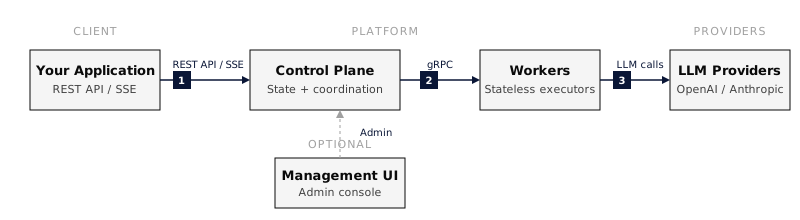
The control plane scales vertically and is fronted by a load balancer. Workers scale horizontally, add more for throughput, remove some to save cost. PostgreSQL is the only piece of stateful infrastructure.
Why a separate worker tier?
Section titled “Why a separate worker tier?”You could run the agentic loop in the API server process and avoid the extra hop. Everruns doesn’t, for three reasons:
- LLM calls are long. A single turn easily spends 10–60 seconds in network I/O. Tying that to the request thread caps API throughput and makes deploys painful.
- Failure isolation. A misbehaving tool that hangs the worker process should not take down the API. They’re separate concerns and they get separate processes.
- Durability. Workers can crash and the task gets reclaimed by another worker. Tying execution to a request would lose the work the moment the connection drops.
The control plane and workers talk over gRPC inside your VPC. End users only ever see the REST API.
Why headless
Section titled “Why headless”Most agent platforms ship a chat UI and treat the API as a side-channel. Everruns inverts this: the API is the product, and the UI is one client among many (the SDK, the CLI, customer-built apps, and the bundled management UI all consume the same endpoints).
The consequences:
- Every feature has to land in the API before it lands in the UI. There are no “UI-only” features.
- You can ship Everruns as backend infrastructure for a product whose UI looks nothing like ours.
- Multitenancy, auth, and quotas are enforced at the API layer, so you cannot accidentally bypass them by using a different client.
The management UI exists for operators, configuring providers, browsing sessions, debugging events, not as the primary interaction surface.
Why REST + SSE, not WebSockets
Section titled “Why REST + SSE, not WebSockets”Sessions need a bidirectional flow: the client posts messages, the server streams events. WebSockets would be a natural fit, but Everruns uses REST for writes and SSE for reads.
- REST is cacheable, debuggable with
curl, and survives every reverse proxy on the planet. - SSE is a one-way streaming protocol that works through HTTP/1.1, HTTP/2, and HTTP/3 with no special infrastructure.
- The events you’d want to push to the server (cancel, new message) are infrequent enough that a
POSTis the right shape.
Combined with since_id resumption and 5-minute connection cycling, SSE gives you reconnection-as-a-feature instead of reconnection-as-a-bug.
Multitenancy and isolation
Section titled “Multitenancy and isolation”Everruns is organization-scoped end-to-end:
- All resources (agents, sessions, capabilities, providers) belong to exactly one organization.
- API keys carry an org membership; the API enforces the boundary on every request.
- Sessions are isolated at the database row level, there is no cross-session filesystem or key-value access.
- Secrets are encrypted at rest with an organization-scoped key chain.
Where the boundaries are
Section titled “Where the boundaries are”Things the control plane owns: auth, durable task queue, event log, virtual filesystem, key-value storage, capability registry, MCP catalog.
Things workers own: nothing persistent. They borrow the database, run their tasks, and report back.
Things your application owns: the agent definitions, the prompt design, and the channel-specific glue (Slack apps, webhooks, schedules). The platform is intentionally neutral about what you build with it.