
Retrieval Citations
| ID | citation_retrieval |
| Category | Knowledge |
| Features | citations |
| Dependencies | None |
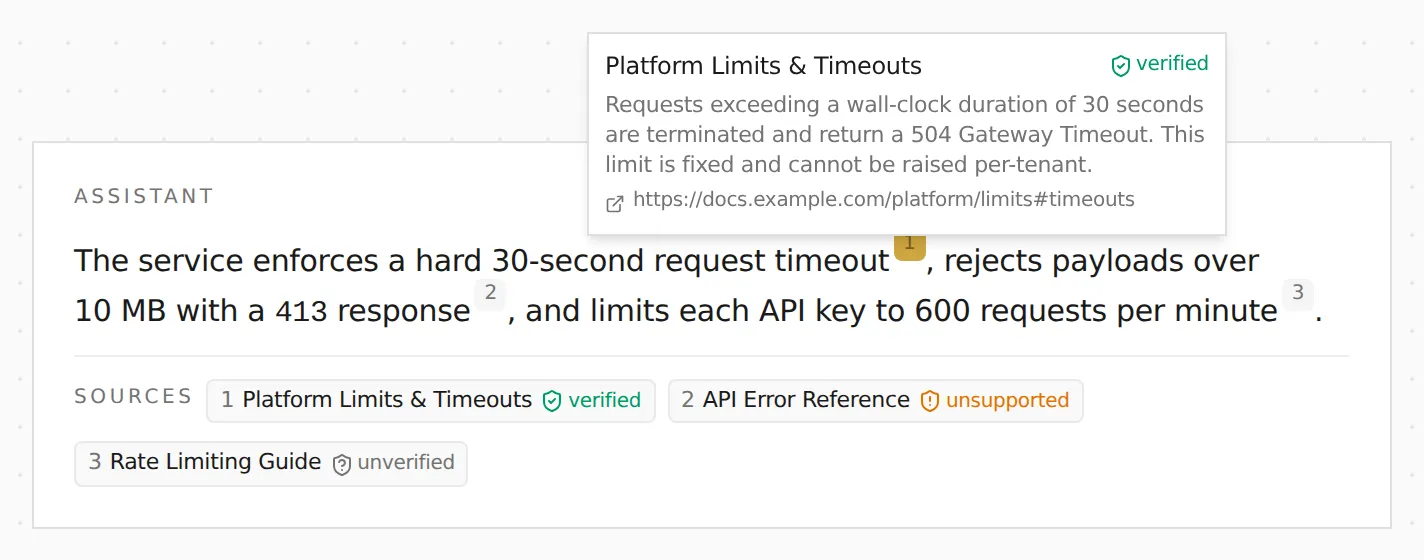
Turn the sources an agent retrieves into claim-level provenance on its answer. When the agent grounds a reply in a knowledge search, citation_retrieval links each grounded sentence to the passage that backs it, and the UI renders those links as inline numbered chips with a hover preview and a deduped Sources strip.
It contributes no tools and no system prompt, and it never rewrites the model’s answer. After the agent responds, it inspects the turn’s retrieval results, aligns each retrieved passage to the sentence it best supports, and attaches a citation there. Alignment is deterministic token overlap, no extra model call, so it is model- and provider-agnostic.
How it looks
Section titled “How it looks”Grounded sentences get an inline numbered chip. Hovering a chip previews the source (title, snippet, and link); a deduped Sources strip sits below the message. When Citation Verification is also enabled, each source carries a faithfulness badge.
Reads the results of the agent’s knowledge retrieval tools:
| Tool | Source shape |
|---|---|
search_index | Knowledge-index chunks (kchk_…), source_uri, document_title, snippet, location |
search_knowledge | Knowledge-base entries (kbe_…), resource, title, snippet |
Both shapes are normalized into the shared citation envelope. A retrieval result with no usable snippet is skipped, there is nothing to align a claim to.
This capability is a no-op on its own. It cites what the agent retrieves, so it only produces citations when the agent also has a retrieval capability (a knowledge index or knowledge base) that surfaces
search_index/search_knowledgeresults. With no retrieval feed, there is nothing to cite and the answer is unchanged.
Configuration
Section titled “Configuration”| Field | Type | Default | Description |
|---|---|---|---|
min_overlap | number (0–1) | 0.5 | Minimum token-overlap ratio for a retrieved passage to attach to a sentence. Overlap is shared tokens / passage tokens, so 0.5 means at least half the passage’s distinctive words appear in the sentence. |
Raise min_overlap for stricter, higher-precision attachment (fewer chips, each more defensible); lower it for broader coverage when the model paraphrases retrieved text.
- No answer rewrite: the streamed answer is never changed; annotations attach to sentence spans after generation.
- Alignment is lexical: a sentence that paraphrases a source heavily enough to fall below
min_overlapwill not be cited. This favors precision over recall. - Enabled by default:
citation_retrievalis part of the generic (default) harness, so any agent with a retrieval feed gets citations automatically. - Persistence: annotations ride the message in the event log, so they survive reload, forking, and session export, no separate store.
- Org scoping: sources are derived only from already-authorized retrieval results, so a citation can never reference a document the requesting org cannot read.
See Also
Section titled “See Also”- Citation Verification, stamp a faithfulness verdict on each citation
- Capabilities Overview