
Tool Search
| ID | tool_search |
| Category | Optimization |
| Features | None |
| Dependencies | None |
Enables deferred tool loading for agents with many tools, on any model. Instead of sending full parameter schemas for every tool upfront, only tool names and descriptions are sent initially. The model loads full schemas on demand by calling the tool_search tool.
Unlike the hosted OpenAI Tool Search and Claude Tool Search, which rely on the provider’s server-side tool_search feature, this capability implements tool search entirely client-side. It therefore works with Gemini, OpenAI Completions, models reached through gateways that don’t implement hosted search, and any other provider — not just GPT-5.4+ or Claude 4. For a default that automatically picks hosted search where available and this client-side path everywhere else, use Auto Tool Search.
tool_search— search the available tools by keyword and load their full parameter schemas.
How It Works
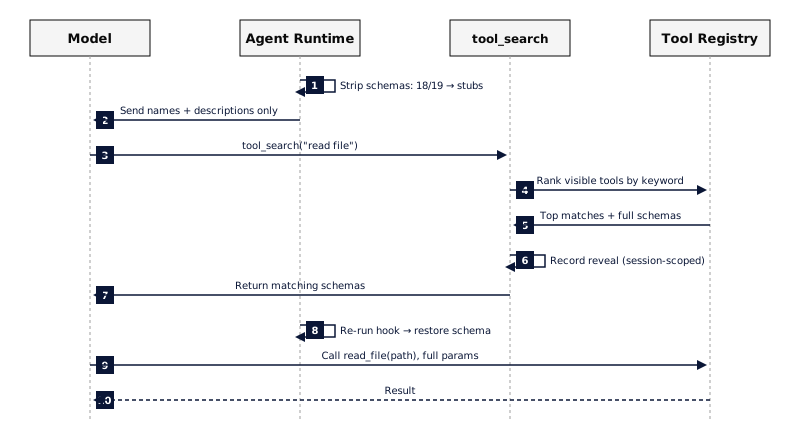
Section titled “How It Works”The diagram below traces one deferred tool through a full round-trip — from schema stripping at context-assembly time, through the tool_search call, to calling the real tool with its restored parameters.
- Threshold check — deferral only activates when the total tool count meets or exceeds the threshold (default: 15). Below it, full schemas are sent unchanged.
- Schema stripping — a tool-definition hook replaces the parameter schema of every deferrable tool with a small stub (name + description survive). This runs when the runtime agent is built, so the model never receives the full schemas upfront.
tool_searchtool — a real tool is added to the agent. When the model calls it with a query, the tool inspects its sibling tools and returns the full JSON parameter schemas of the matches.- Progressive disclosure —
tool_searchalso records the matched tools as revealed. The hook re-runs on every reasoning iteration, so on the next step the revealed tools are advertised with their full, authoritative schema on the registered definition. This is what lets a structured tool caller actually pass arguments to a previously deferred tool, rather than only reading its schema as text. - System-prompt guidance — a short note instructs the model to call
tool_searchbefore using a tool whose parameters it has not yet loaded. - Transparent execution — the underlying tools stay registered and executable. Tool calls and results work identically; only how schemas reach the model changes.
DeferrablePolicy
Section titled “DeferrablePolicy”Each tool has a deferrable policy that controls whether its schema can be deferred:
| Policy | Behavior |
|---|---|
never | Full schema always sent (use for high-frequency tools like write_todos) |
automatic | Deferred when tool_search is active and above threshold (default) |
always | Always deferred when tool_search is active |
The tool_search tool itself is never deferred.
Never-defer allowlist
Section titled “Never-defer allowlist”DeferrablePolicy::Never is set by the tool’s owner. An embedder that composes tools it does not own (for example file/shell tools from another crate) can instead keep specific tools fully loaded by name:
- Programmatically:
ToolSearchCapability::with_never_defer(["read_file", "bash", ...]). - By configuration: a
never_deferarray (merged with any programmatic list).
Allowlisted tools behave exactly like DeferrablePolicy::Never tools — their full schema is always sent — so the agent is never forced through a tool_search round-trip before its first read/edit/shell call.
Search ranking and result bounding
Section titled “Search ranking and result bounding”Because there is no hosted semantic index, tool_search ranks matches client-side with a deliberately simple, predictable scheme:
- Field-weighted keyword overlap — each whitespace-separated query term scores 3 if it appears in a tool’s name and 1 if it only appears in the description. A name hit is a far stronger signal of intent than an incidental word in prose, so it dominates.
- Exact-name bonus — a query that is exactly a tool name gets a large bonus (+100), so “load this specific tool” always ranks that tool first. The deferred stub tells the model to query the exact tool name, so this is the common path. Wrapping punctuation is stripped first, so a quoted or backticked name (
"read_file",`read_file`) still matches. - Top-band cutoff — only results scoring at least half the top score are returned, trimming weak tail matches so a loose query does not drag in loosely related tools.
- Result cap — at most 8 tools are returned per call. Every returned tool is also revealed (its full schema is un-deferred for the rest of the session), so the cap bounds both the response payload and how much of the catalogue a single search can permanently un-defer.
- Visible-tool scoping — the search only considers tools visible in the current turn (the turn-scoped allowlist), so it never reveals a tool the agent could not otherwise call.
- No-match fallback — if nothing matches, the tool returns the catalogue of available tool names (not schemas) so the model can refine its query instead of dead-ending. An empty query lists tools so the model can browse.
The session reveal set that drives progressive disclosure is itself bounded: it is keyed per session and evicts the oldest sessions past a fixed cap, so reveals never leak across sessions or grow without limit (an evicted session simply re-runs tool_search).
Model Support
Section titled “Model Support”None required. Because deferral and search are implemented client-side, every model works the same way. For GPT-5.4+ you may prefer OpenAI Tool Search, which uses the provider’s hosted index; use this capability for all other models.
Configuration
Section titled “Configuration”{ "capabilities": ["tool_search"]}The activation threshold defaults to 15 tools (DEFAULT_TOOL_SEARCH_THRESHOLD). Both the threshold and a never-defer allowlist can be set via capability config:
{ "capabilities": { "tool_search": { "threshold": 20, "never_defer": ["read_file", "write_file", "edit_file", "list_directory", "grep_files", "bash"] } }}Benchmarks
Section titled “Benchmarks”Deferral only touches how tool parameter schemas reach the model — names and descriptions still go out in full — so the savings scale with how many tools an agent carries and how rich their schemas are.
Measured on a representative 19-tool generic-agent surface (file, shell, web-fetch, session, storage, todo, time, and subagent tools, plus tool_search itself), comparing the serialized tool list the driver sends to the model with and without deferral on the first turn:
| Metric | Full schemas | Deferred (first turn) | Saving |
|---|---|---|---|
| Tool list sent to model | ~11.6 KB (~2,900 tokens) | ~7.0 KB (~1,760 tokens) | 39% smaller |
| Parameter-schema bytes only | ~8.3 KB | ~3.7 KB | 55% smaller |
Token figures use the ~4-chars-per-token rule of thumb for JSON. 18 of the 19 tools were deferred (tool_search keeps its schema). Net savings grow with tool count: an agent with dozens of MCP tools defers proportionally more.
These numbers come from the benchmark_prompt_size_reduction test in crates/core/src/capabilities/tool_search.rs, which also guards the reduction against regressions. Reproduce them with:
cargo test -p everruns-core --lib benchmark_prompt_size_reduction -- --nocaptureThe trade-off is one extra tool_search round-trip per deferred tool before its first use; for many-tool agents the upfront token savings dominate.
Limitations
Section titled “Limitations”- Server-executed tools — the search reads schemas from the worker-side tool registry. This includes built-in tools and MCP server tools (MCP tools are registered as first-class registry tools). Client-side tools that are not registered worker-side are not returned by
tool_search(their stripped definition is still sent so the model knows they exist). - Extra round-trip — loading a schema costs one
tool_searchcall before the first use of a deferred tool. The token savings outweigh this for agents with many tools.
See Also
Section titled “See Also”- Auto Tool Search — model-adaptive default (hosted where available, this client-side path elsewhere)
- OpenAI Tool Search — hosted deferred loading for GPT-5.4+
- Claude Tool Search — hosted deferred loading for Claude 4+
- Capabilities Overview