
Everruns Cloud changelog
October 2026
Call one agent from code with an Agent API key
An Agent API channel gives an application a key that reaches one agent's sessions, with streaming, approvals, end users, browser origins and spend limits.
Tools in Shell runs an agent's tools from Bashkit scripts
The tools_in_shell capability moves most tools into one tools shell command, so a script can chain calls, preview them with tools plan and ask approval first.
Session Trace view replaces Transcript and Timeline
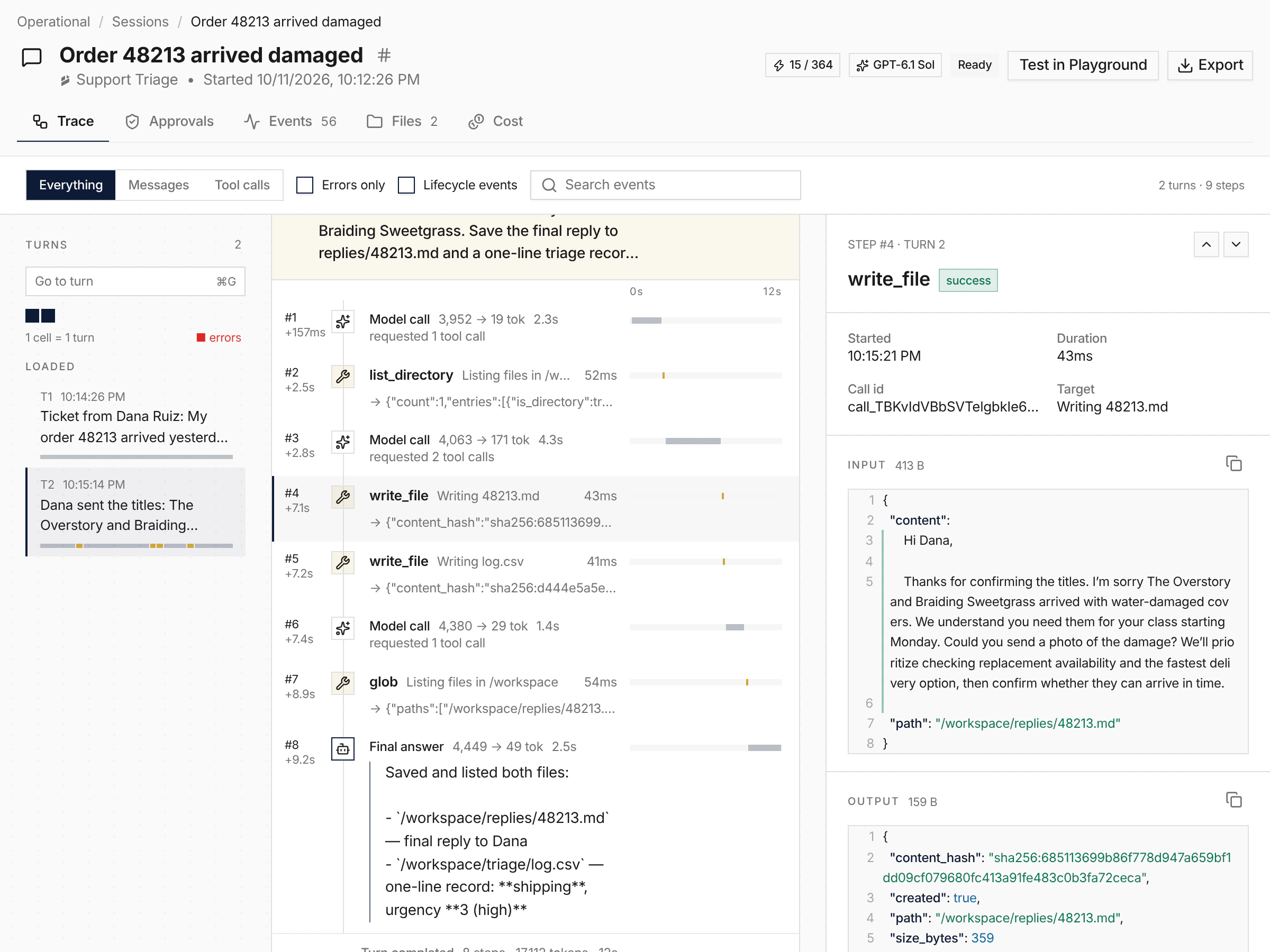
Sessions open on a Trace tab that lays out turns and steps with timing bars, an inspector for each step's input, output and model request, and event search.
Session SQL databases survive server restarts
Session SQL databases are now stored in PostgreSQL page by page, so a server restart no longer loses them and every server instance sees the same data.
Everruns agents act as Poppy personal agents
The poppy_client capability lets an Everruns agent find a company's agent through the Personal Agent Protocol, talk to it and hand off to a person there.
Add your own MCP servers and use them in chat
People add personal MCP servers in Settings, and agents with the User MCP Servers capability use them, including servers connected in the middle of a chat.
Label MCP tools as read only or changes things
Save a risk label on each tool of an organization MCP server to decide whether it asks for approval, with model-suggested labels a person can accept.
Built-in harnesses reorganized as a tree by use case
Base, Conversation, Worker, Bashkit Worker and Sandbox Worker now form a tree of built-in harnesses, and existing Worker bindings move by sandbox policy.
Pick and configure guardrail checks in the agent editor
The Guardrails settings panel lets authors add presets or single checks and set their stage and action, and model-backed checks can now judge the final reply.
GitHub triggers wake agents on CI results
GitHub triggers now receive workflow run and check suite completions, and a changes-only filter wakes the agent only when a workflow's CI result changes.
Explicit communication lets agents choose when to reply
An agent's Communication setting can be Explicit, so assistant text stays as private notes and the agent speaks only through send_message or stays silent.
Outbound network policy modes, audit log and org allowlists
Operators choose open or curated outbound access, every outbound request is audited with its org and session, and admins can widen the allowlist for one org.
Everruns Cloud verify-email screen sends a new link again
The email verification step on Everruns Cloud now offers Sign in again, which sends a fresh link, replacing a resend action that never sent any mail.
Everruns Cloud shows spend per model and agent on a Usage tab
A Usage tab breaks down Everruns Cloud charges by day, model and agent with token counts and CSV export, and a credit chip and banner warn on low credit.
ChatGPT plan connections no longer need a feature flag
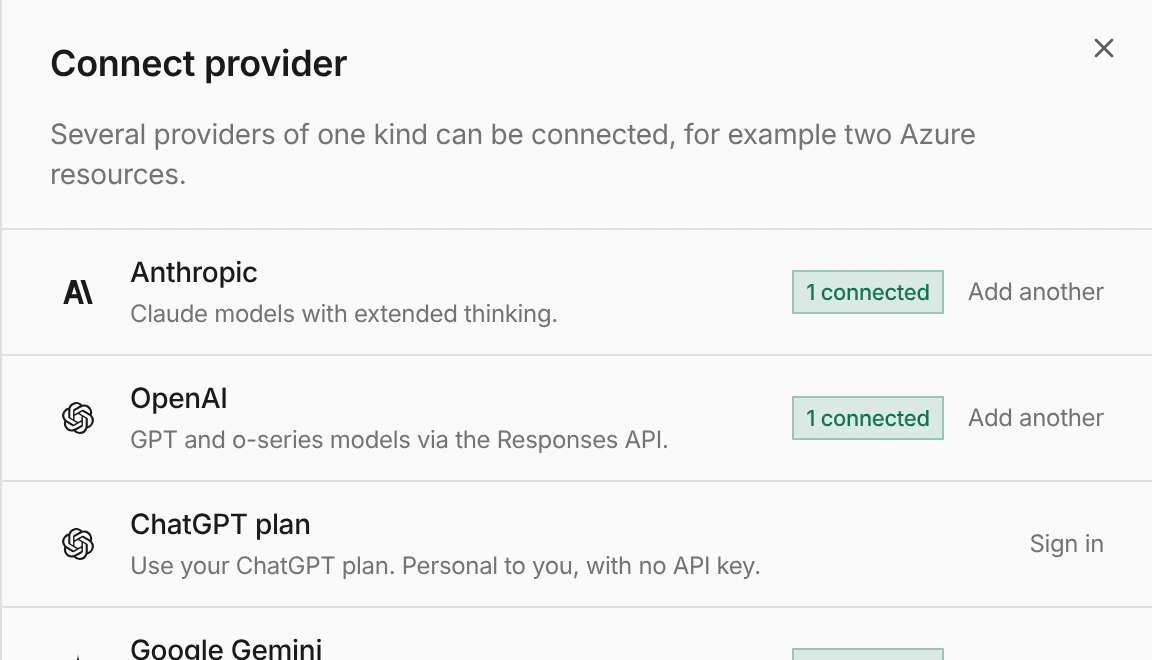
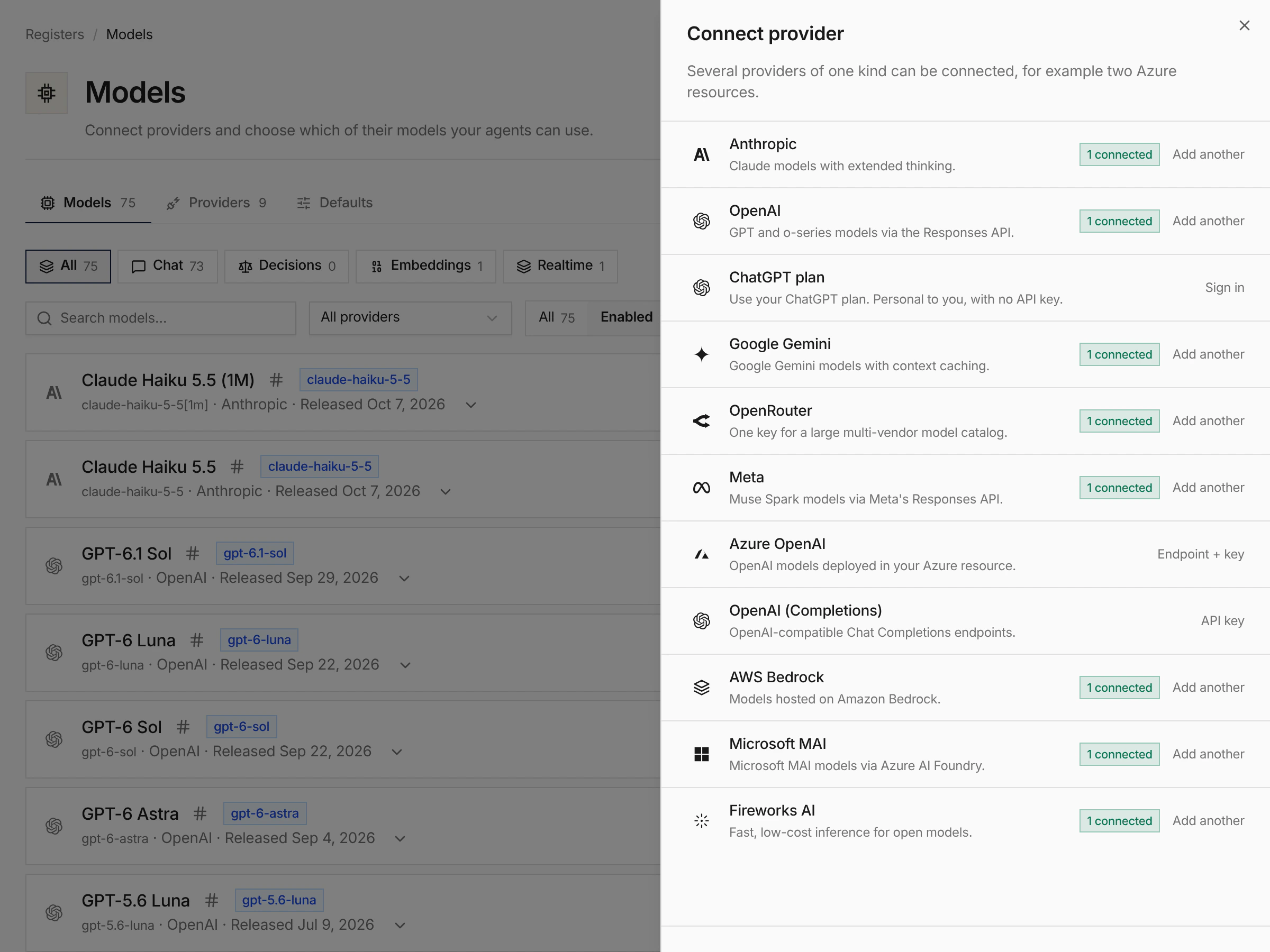
The ChatGPT provider now shows in Connect provider on every deployment, including Everruns Cloud, because signing in is already personal to each user.
Rate agent replies and branch a chat from any message
Agent replies in Chat get Good, Bad and Branch into new chat actions, and each message shows one status row from sending until the answer arrives.
api_endpoint channels convert to Agent API channels
Existing api_endpoint channels become Agent API channels at startup with the same keys, and old request shapes now return api_endpoint_retired or HTTP 410.
Agents must give a reason for every change by default
Require reasons from agents is now on by default, so an agent's change without a reason fails with reason_required; organizations can turn the flag off.
Agent budgets stop turns before each model call
Agent budgets are now checked before every model call in the native agent loop, so an exhausted budget stops the turn with a typed reason and budget events.
Voice channels let people call an agent
A voice channel lets people talk to an agent over WebRTC while it keeps its own model, tools and instructions, on the platform and in the Framework.
Models and providers move into one registry page
Registries → Models now holds Models, Providers and Defaults tabs, so connecting a provider, choosing its models and setting org defaults happen in one place.
See and revoke AI clients connected to Everruns
Settings → My agent experience lists the AI clients you connected to Everruns over MCP OAuth, shows when each was last used, and lets you revoke one.
app.everruns.com serves llms.txt and auth.md for AI agents
AI agents and crawlers can discover Everruns Cloud from app.everruns.com itself through llms.txt, auth.md, Link headers, robots.txt and a sitemap.
Fix ChatGPT plan sessions failing with HTTP 400
Sessions that use a ChatGPT plan connection no longer fail with HTTP 400, because Everruns stops sending request-body metadata the Codex backend rejects.
Agents home and a New agent page with an agent builder
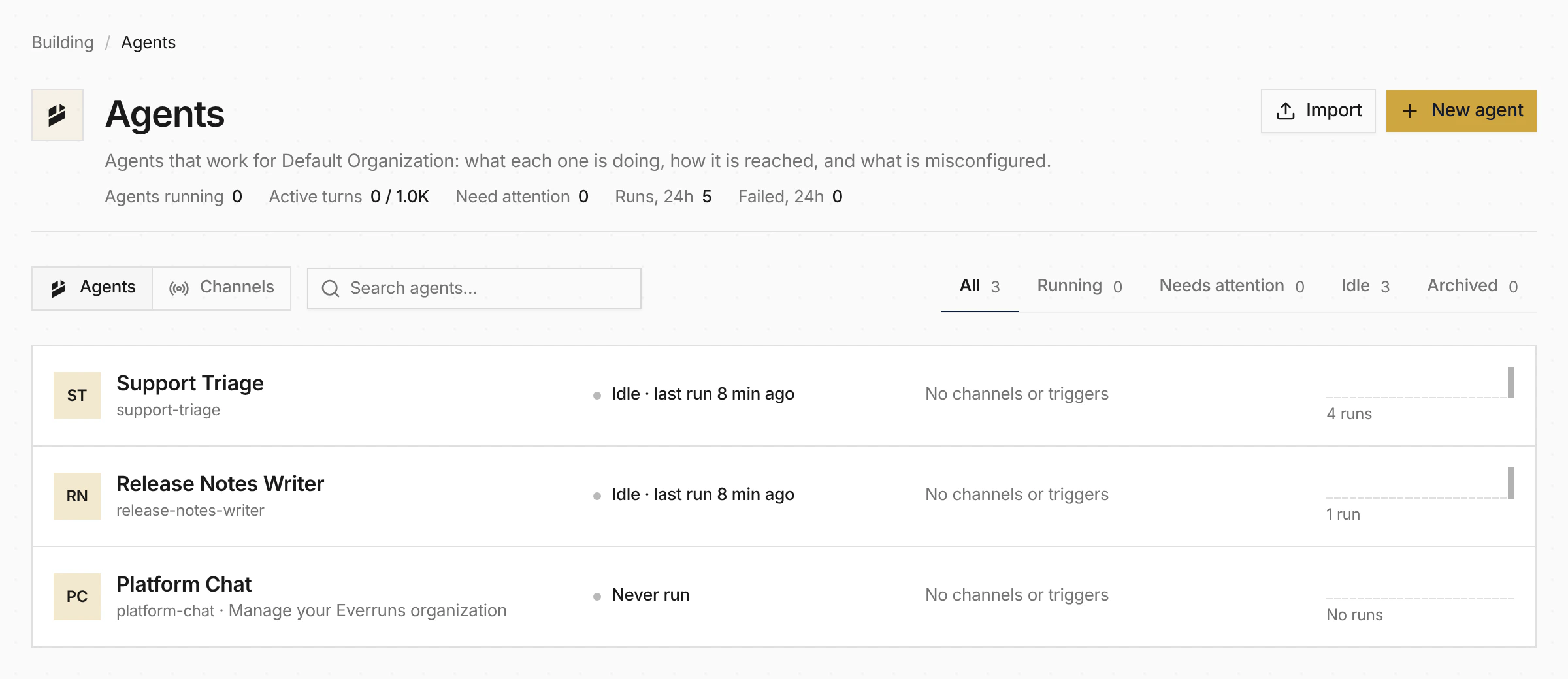
The Agents page now shows run activity, channels and setup problems for each agent, and New agent drafts an agent from a description, an example or an import.
Save shell scripts on agents and run them from triggers
Agents keep named shell scripts that run in Bashkit with their tools, and schedule or webhook triggers can run one with the event payload and no model call.
Desktop computer use on E2B and Daytona sandboxes
Experimental capabilities run the computer tool on a full Linux desktop in an E2B or Daytona sandbox, now with zoom, cursor, mouse button and hold-key actions.
Coordinator threads in Platform Chat and the Framework
Platform Chat and Framework agents can hand focused work to child threads and keep a board of what is working, what needs you and what is ready for review.
Browser tool for agents on Browserless
The experimental browser_use capability lets an agent read pages as an accessibility tree, act on elements by ref, fill forms and manage tabs in Browserless.
Claude Haiku 5.5 model added for Anthropic providers
The claude-haiku-5-5 model and its 1M-context twin are seeded as an enabled favorite, with adaptive thinking, tool search and the computer toolset.
Sign in to channels and Public Chat with AgentID
A2A, AG-UI and Public Chat channels accept AgentID tokens, Public Chat shows Continue with AgentID, and agents can sign in to apps with their AgentMail inbox.
A2A channels serve HTTP+JSON and the PACT profiles
Every A2A channel also answers the A2A 1.0 HTTP+JSON binding, and a channel can accept personal agents through the PACT Identity and Delegated profiles.
Change history with reasons and restore for every entity
Every configuration change records who made it, through which surface and why, with numbered revisions you can compare and restore from the History menu.
Agent versions are retired in favor of change history
Agent publishing, default versions and version pins are removed; channels, triggers and sessions now run the agent's current configuration instead.
Sandbox Templates and a Sandboxes fleet view
Reusable Sandbox Templates with immutable revisions decide where an agent's commands run, and a fleet page lists every sandbox in the organization.
Agents get avatars from presets or an uploaded image
Give an agent an avatar from 25 curated presets or a cropped upload, and it shows in the console, on the A2A Agent Card and as the Slack app icon.
Slack permission issues appear in Health with recovery steps
Slack installations missing a permission or credential raise a persistent issue in Settings > Health, with guided recovery, per-user snoozing and rechecks.
Playground for testing agents, and Chat as one permanent conversation
Agent testing moves to a shared Playground where members pick the agent and the user it runs as, while Chat becomes your permanent Platform Chat conversation.
Conversation becomes the default harness and Generic is deprecated
Built-in harnesses form progressive presets from Base to Worker, Conversation is the new default, and agents that inherited Generic are pinned to it on upgrade.
Computer use capability lets agents operate a browser screen
The experimental computer_use capability drives a Browserless page with clicks, typing and screenshots, using native OpenAI or Anthropic tools when available.
Chat threads keep conversations and ongoing work beside Chat
Organizations can opt into Chat threads, a panel beside the permanent Chat for searching conversations, following background work and resolving threads.
Approval history in chat and a new Approvals audit page
Chats show approval requests and recorded consent as clear entries, and organization admins get an Approvals page that filters approvals across sessions.
Cloudflare AI Gateway and Vercel AI Gateway model providers
Agents can run models through Cloudflare AI Gateway or Vercel AI Gateway, and the Cloudflare provider lists Workers AI text-generation models automatically.
AG-UI 1.0 endpoint and AG-UI streaming for Framework sessions
The AG-UI channel moves to protocol 1.0 with interrupts, resume, frontend tools and subagents, and any Framework session can serve AG-UI from your own server.
A2A 1.0 endpoint with task results, streaming and push notifications
Everruns A2A channels negotiate protocol 1.0, return agent output as task artifacts, support ListTasks and SubscribeToTask, and send push notifications.
Connect several Slack workspaces per organization
An organization connects its Slack workspaces once in Settings, and adding an agent to Slack becomes picking a workspace and approving one consent screen.
OpenAI structured output and background mode for long reasoning
OpenAI drivers enforce JSON Schema structured output, and xhigh or max reasoning calls run as background responses that resume after a drop or worker restart.
MCP Events add session webhooks and triggers on MCP server events
With the experimental MCP Events flag, MCP clients subscribe to signed session webhooks, and agents wake on events published by their own MCP servers.
PR reviewer and security scanner agent templates for GitHub
Two guided agent templates use the agent's GitHub App to review pull requests with inline comments and to run a weekly scan that files GitHub issues.
September 2026
OpenAI hosted code interpreter, shell, file search and remote MCP
The openai_server_tools capability adds code interpreter, hosted shell, file search and approval-gated remote MCP next to web search on OpenAI Responses agents.
GitHub pull request triggers with a per-agent GitHub App
Each agent can create and install its own GitHub App by clicks, read pull requests and diffs, post comments, and start sessions from pull request events.
Claude Sonnet 5.5 and GPT-6.1 Sol with fast and ultrafast tiers
Claude Sonnet 5.5 becomes the favorite Sonnet model, GPT-6.1 Sol adds fast and ultrafast speed tiers, and the sunset Claude Sonnet 4.5 profile is removed.
Everruns MCP server renders as an MCP App in ChatGPT and Codex
MCP App hosts such as ChatGPT and Codex show a live session view, answer agent questions in a form, approve pending actions and open an Everruns panel.
Agent page rebuilt as one view-and-edit workspace
The agent page shows the system prompt as the page with settings in a side column, and you edit everything in place with one Save or Discard.
Ask User questions reach MCP, A2A and Tasks clients
A session waiting on ask_user now shows its question to MCP clients as a form elicitation, to A2A callers as a typed data part, and to Tasks clients.
Ask User lets agents pause and ask you questions mid-run
Agents with the ask_user capability pause a run to ask one to four choice, text or secret questions, shown as an inline card that you answer in place.
Claude always-thinking models no longer return 400s or empty answers
The Anthropic driver rejects prefill early, maps an explicit none effort to low, and keeps requests append-only on Opus 5.5 and other always-thinking models.
Everruns Cloud sign-in failures return to the login page
A failed Everruns Cloud sign-in now lands on the login page with the reason and a way to try again, instead of a raw JSON error on the callback URL.
Claude Opus 5.5, GPT-6 Sol and GPT-6 Luna models added
Claude Opus 5.5 becomes the recommended Opus model, and GPT-6 Luna replaces GPT-5.6 Terra as the platform default model and the default utility model.
Install an Everruns agent in Slack with one click
Connecting an agent to Slack no longer needs credentials copied from api.slack.com: Everruns creates the Slack app and takes its credentials from OAuth.
MCP catalog presets, acts-as identity and personal connections
MCP servers gain an org catalog of presets, an actsAs setting for whose sign-in a server uses, an agent MCP tab and a place to revoke your own sign-ins.
Set spend budgets on agent endpoints from the Integrations tab
Agent and endpoint budgets can be managed on the agent's Integrations tab, and sessions are attributed to the endpoint they arrived through.
Slack agents ask approval with buttons and show task progress
Agents deployed to Slack can take approvals through Approve and Decline buttons, show live sub-task progress and act as the channel's own bot.
Agent endpoints and triggers replace Apps in Everruns
App management is retired: an agent's endpoints and triggers now live on its Integrations tab, with an org-wide Exposures view and per-agent suspend.
Soft approval: agents pause before destructive or outward actions
The new soft_approval capability, on by default for Generic and Platform Chat, has agents ask before risky actions and records who approved in the audit log.
One everruns command line for the CLI, MCP and agent shells
Every Everruns operation now has one noun-verb spelling with --help that works the same in the everruns CLI, the /mcp endpoint and an agent's shell.
The Everruns UI supports dark mode with a theme setting
The Everruns web UI can now be shown in light, dark or system theme, chosen from the user menu and remembered without a flash on navigation.
Everruns agents run in Slack's agent pane
A Slack channel can now serve Slack's agent pane, with streamed replies, a stop button, live status and thread context, alongside channel replies.
Everruns Cloud adds a built-in model provider with starter credit
New Everruns Cloud organizations run agents without provider keys, paid from prepaid credit that starts at $5 and is topped up in Settings > Billing.
Sessions show where their commands run and what they may touch
Each session now declares its execution environment, readable through the API and shown in an Environment panel on the session Workspace tab.
Everruns Cloud loads Sessions, Harnesses and Skills pages faster
Moving between the Sessions, Harnesses and Skills pages on Everruns Cloud no longer stalls for seconds while the server renders the page.
Send a message and wait for the turn result in one request
The sessions API can now hold a message request open until the turn finishes, and Framework runs accept a timeout, for callers that do not consume SSE.
Attach PDF files to agent messages
Messages can now carry PDF attachments, uploaded through a new files API and passed to each provider in its native document format.
Session schedules no longer fire twice on multi-replica deployments
Everruns servers running more than one replica now claim each due session schedule atomically, so a scheduled message is sent once.
platform_management capability retired in favor of platform
Capabilities gain a deprecated and retired lifecycle, and platform_management is the first one retired: it stays registered but no longer contributes tools.
Every Everruns user starts in a pinned Platform Chat thread
New users now land in a precreated, pinned Platform Chat thread instead of an empty Chats list, and Platform Chat gains more built-in capabilities.
Image generation adds the Muse image model with a fallback
The image generation capability can now use Meta's Muse image model through Meta or OpenRouter, and falls back to it when only those credentials exist.
Connect an LLM provider with one pasted key, checked before saving
LLM provider setup now offers a one-click grid of common providers, verifies the API key with the provider, and enables models and a default for you.
Everruns servers publish an MCP server card and auth.md
Every Everruns deployment now serves an MCP Server Card and an auth.md document, derived from live config, so agents can discover how to connect.
AGENTS.md files resolve hierarchically as conversation context
Agent instructions now load AGENTS.md from the workspace root down to the working directory and place them below harness safety instructions.
GPT-6 Astra, Claude Fable 5.1 and Muse Spark 1.3 model profiles
Everruns adds model profiles for OpenAI GPT-6 Astra, Claude Fable 5.1 and Muse Spark 1.3, seeds them for new organizations and covers them in live tests.
MCP URL elicitation pauses for consent in the Everruns UI
When an MCP tool asks a person to finish a step in the browser, the turn now pauses on a consent card and the secret never enters the model context.
August 2026
Tool calls are validated against their schema before running
Everruns checks every tool call's arguments against the tool's JSON Schema and enables strict schemas for compatible OpenAI Chat and Responses tools.
Only organization admins can rename an organization
Every PATCH /v1/orgs/{org} request now requires an organization admin, closing a path where members could rename non-default organizations.
Organization default model can fall back to the platform default
An organization's default model is now an explicit override that admins can clear, falling back to a platform default shown in Models and Settings.
First message of a new chat no longer drops or shows out of order
A new chat thread now replays from its first event when it subscribes, so the opening message is delivered and appears above later replies.
Everruns ID adds a sign-up page and branded account emails
Creating an Everruns Cloud account now has its own sign-up page, and the verification and password-reset emails use the Everruns layout with a fallback link.
Messages API reports reasoning in order and the message phase
Session messages now carry ordered reasoning parts plus phase and phase_source, so clients can tell intermediate commentary from the final answer.
Global chat session endpoints removed from the Everruns API
POST /v1/sessions/chat and POST /v1/sessions/chat/voice are gone; create a chat thread as an ordinary session with POST /v1/sessions instead.
Agents read several workspace files in one read_many_files call
The File System capability adds read_many_files, which reads 2 to 10 independent files in one ordered call and halves model round trips for discovery.
Session pages show a generated run summary and tab counts
A finished run gets a one-sentence summary in the session header, and the Work, Events and Workspace tabs show how many items each holds.
Archive finished chats and show them again on demand
Archiving hides a chat thread from the Chats list without deleting it, and a Show archived filter and the archive API bring it back when needed.
Provider connections carry custom headers and cache diagnostics
An organization can set extra HTTP headers and a prompt cache diagnostics opt-in on a provider connection, applied to every model call made through it.
Start a chat with any harness, not only an agent
The New chat picker lists active harnesses, including Generic, Base and custom ones, next to agents, so a chat no longer needs a placeholder agent.
Knowledge index embedding spend is metered and ledgered
Query embeddings made by search_index now count toward session cost and budgets, and index-sync embeddings are recorded against the organization.
Session recordings split into Transcript, Timeline and Events
A session page now offers three full-width views of a run: a read-only conversation replay, a curated execution history and the raw event ledger.
Chats is on for every organization, with pinned chats
Chats no longer depends on a feature flag, so every organization gets the chat list, search and new-chat flow, and threads can be pinned to the top.