
Framework Architecture
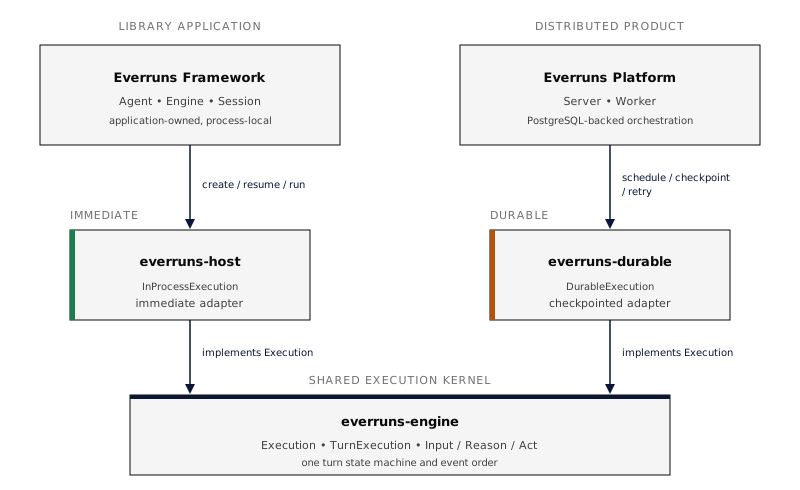
Everruns has one turn model and two ways to execute it. A library application
uses the concrete everruns::Engine in its own process. The Everruns Platform
uses server and worker services with durable checkpoints. Both paths converge
on the same everruns-engine Input/Reason/Act state machine.
Public Framework objects
Section titled “Public Framework objects”| Object | Responsibility |
|---|---|
Agent | Immutable behavior: instructions, model and provider, tools, capabilities, files, and lifecycle hooks |
Engine | Concrete process-local owner of Agent snapshots, session identity, backends, history, and resume authority |
Session | First-class, engine-bound conversation used for turns, steering, events, cancellation, inspection, and history |
Environment | Session resources, including one exact backend-owned workspace head and typed extensions |
New Framework code creates and resumes sessions through an Engine:
use everruns::{Agent, Engine, OpenAI};
let agent = Agent::builder()    .instructions("Answer concisely.")    .provider(OpenAI::from_env()?)    .model("gpt-5.6-terra")    .build()?;
let engine = Engine::new();let session = engine.create(agent);let session_id = session.session_id();let turn = session.send_and_wait("Begin.").await?;assert!(turn.success);
drop(session);let resumed = engine.resume(session_id).await?;assert_eq!(resumed.session_id(), session_id);
InMemoryEngine remains a compatibility alias. It is not a second engine
implementation; use Engine in new 0.18 code.
Two execution paths, one kernel
Section titled “Two execution paths, one kernel”The library path is immediate. everruns::Engine uses everruns-host to run
InProcessExecution in the caller’s process. It can be entirely volatile or
use the local profile for crash-durable canonical events.
The Platform path is distributed and checkpointed. The server schedules work,
workers resolve host services and effects, and everruns-durable advances a
DurableExecution across persisted phase boundaries. PostgreSQL remains the
source of recovery state.
Neither path owns a private copy of the turn algorithm. everruns-engine owns
the Execution contract, TurnExecution state, Input/Reason/Act atoms, phase
ordering, and effect production. Immediate and durable adapters select where
state lives and how work is scheduled.
Choose a recovery boundary
Section titled “Choose a recovery boundary”- Volatile Framework:
Engine::new()is offline and database-free. The creating Engine can resume a dropped Session, but process exit loses it. - Local crash-durable Framework:
LocalConfigstores canonical events and session identity locally. Rebuild the trusted Agent configuration, attach it to a new Engine, and resume by typedSessionId. - Distributed durable Platform: server and workers checkpoint workflow state in PostgreSQL and recover across process or worker loss. Applications call it through the remote API or SDKs rather than configuring the facade Engine.
See Persistence and Session History and Resume for the exact application lifecycle.
Extension boundaries
Section titled “Extension boundaries”Normal applications depend on everruns. everruns::Engine is concrete and is
not implemented by applications. Provider integrations implement the open
ChatDriver boundary, while canonical storage hosts can implement
EventLog/EventReader through everruns-host.
An application that is itself an execution host may compose
everruns-engine::Execution with everruns-host or everruns-durable. That is
an advanced deployment boundary: preserve event ordering, workspace isolation,
credential separation, cancellation, and committed effect semantics. Start
with Custom Backends before crossing it.